
Ba da ba da ba da da
Ba da ba da ba da da
This onamonapia-ish moment is brought to you by every person that ever tried to sing a 7/8 groove to a drummer. But are playing in odd times really as much of a hard-mode thing as we’ve been let on?
Put simply, No. They are difficult to feel when you first start playing them because our western brains are so attuned to hearing music in 4, 3, or 6 that bars that end anywhere else feel wrong. If you were to travel east and stopped at various cities between where you’re at and Mumbai you would hear a sharp increase in odd time usage the further east you traveled.
But … why? Well the answer takes us all the way back to the medieval church. Yes, 4/4 was adopted as the standard time with 2/4 being accepted and 3/4 was considered the most holy. Anybody want to guess why? Anyone? Because 3 beats represented the father, son, and Holy Spirit and that’s pretty much it. Considering the church comissioned a lot of music back then it would make sense that those time signatures would be used the most. Areas of the world that didn’t feel the same influence of the Christian church weren’t as compelled to stick to the same conventions.
What does that mean for us? We have some catching up to do and if you’ve read my posts before you’ve already started (gold star for you!)
Ready to have your noodle throughly baked? You use complex odd times, irregular groupings, and shifting times and tempos every single day of your life. Some of you do A LOT more than others, some people do it so much we wish they would stop for a little bit. If you haven’t guessed what I am mean, let me ask you this: Have you ever paid attention to the way you talk? The rhythms that happen when you talk in a regular conversation would have a music theorist pulling their hair out if they had to transcribe it to paper. I know what you’re thinking “yeah but I’m just talking and that’s not music.”
Allow me to retort with question then: What IS music? And no, I’m not going to transcribe your conversation; I happen to like my hair.
Now, let’s break down some of the more commonly found odd times in music. We are going to look at 5 and 7 and really for this the bottom number really isn’t important, our main focus is the number of beats not what each beat is worth.
In the past I broke down rhythms using four letter words to reflect the 4 16th notes that make for 1 quarter note. I used the words “kick” and “snap” because they sounded a little bit like a drum beat.
To recap:
Kick = 1 beat (which would either be 1/4, 2/8, 4/16, 8/32. 16/64, 32/128, or 64/256 – See why we aren’t going to mess with the bottom number now? But for funsies these will all either be 1/4 or 2/8 if you absolutely HAVE to know)
Kick | Snap = 2 beats
Kick | Snap | Kick = 3 beats
Kick | Snap | Kick | Snap = 4 beats
Kick | Snap | Kick | Snap is a prime example of exactly what a bar of 4/4 sounds like, if you just listened to a song on the radio 90% of the time it’s in 4/4. Peole tend to “feel” 4/4 time from the 2 and the 4 which is often where the snare hits. If you’ve been to a concert and the crowd started clapping, they were clapping on the 2 and the 4 (unless you were at a concert full of unholy hethens who clap on 1 and 3, please don’t do that). The easiest way to tell that you are dealing with a song in any kind of odd meter is by tapping your foot, if your tapping magically changes from 2 and 4 to 1 and 3 odd things are afoot! No … pun … intended. We are going to use the foot tapping technique for the majority of this because your body will naturally detect the tempo and the rest is just tapping your foot to the beat.
Get your foot ready, we’re going to start tapping.
I’m sure everyone has heard this. I want you to listen to it, tap your foot and pay attention what happens to your foot tap.
Sorry if you’re not a horror movie fan. If you noticed, your foot absolutely switched from 2,4 to 1,3 but let’s get weirder! This time tap your foot twice as fast, yes now instead of 2,4 we are just going to tap out ALL the beats. Ready? Give it another go, believe it or not this is going to be harder because you are going to have to find 1 and that is can be a bigger challenge than you realize.
Foot ready? Here we go. This time I want you to give it a few times and count how many times you tapped your foot.
How did you do? Were you able to find 1? How many times did you tap your foot?
If you said 5 you win! The Halloween theme is in 5, good job! And you doubted yourself, I told you that you’ve got this.
Okay, lets get out of the soundtrack world and into Seattle in the 90s. Submitted for your approval is “Them Bones” by Alice in Chains
Arm your foot!!
And go ..
How did you do? Did your foot make the switch again? You know what we have to do. Check it out again and tap your foot twice as fast again and give try counting again. I will let you in on a trick to counting, every number aside from one can be counted in 2s and 3s. So if you were counting 5 it is much easier to count 1 2 1 2 3 instead of 1 2 3 4 5. The 1s you are counting gives you a landing zone and helps to keep you from losing count. If you still haven’t gotten it, try it again doing that.
How did you do? Did you make it to 7? If you did you are 100% correct Them Bones is in 7. You are officially counting meters at this point and that is a legitimate skill and I can almost promise that the person sitting next to you cannot do that. Is it really necessary to be able to do this? It depends to be completely honest. Some people are just happy to hear something and that’s enough but there are some people out there who want to peel the layers back and find what it is that they like and don’t like in the songs they are listening to. Either way it’s fun to do for people and everyone will think you are a musical genius and that’s just fun.
Your homework: Find more songs, count along and see what you find. You never know, you may surprise yourself and find that you want to hear music that is more complex. Just like when we were kids and hated the foods you now enjoy, you’re palate can only become better the more you introduce to it. Now go be geniuses.
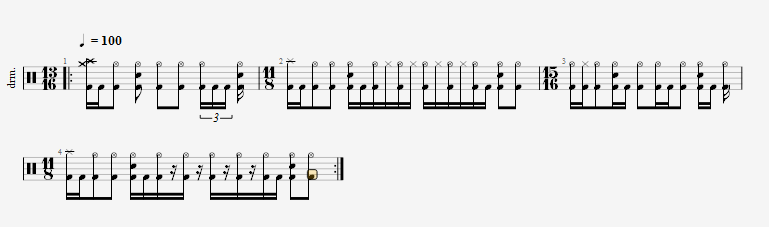
Want to challenge yourself? Below is a link to one of my own songs At the Gates and this part is all over the place musically. Get your foot ready to tap really fast and tell me how you do (don’t worry the link is queued up to the exact place). I’ll even post the drum groove so you can follow along so you can see where things go. Have fun and good luck!
Until the next time!
Mike
 Humble Opinion